Sales Cloud for Marketing 2: Programs to Campaigns

Welcome to part 1 of my “Sales Cloud for Marketing” series, where I will discuss how to force Marketing and Sales to work together to make data that we can use.

Today’s topic: building Marketo programs that play nice with Salesforce.

To start off, let’s make sure we get the nomenclature down. In Marketo, a program is a collection of things, essentially, that all come together to send/share/receive information with people, be they potential prospects or existing clients. When I speak to the marketing team, I generally tell them that, at a high level, a program is what we might more traditionally consider a campaign.

In Salesforce, they are still called campaigns.

To be 100% honest, I don’t know why Marketo chose to call them programs, I really don’t. I’ve searched, but I’ve never gotten a clear answer. I can’t imagine it was a trademark issue…

Anyway, point is, when you think of a marketing campaign – a coordinated set of steps that are used to promote a product or service – think “program.”

First thing’s first…

You’re going to need to ensure that your channel setup makes sense in both Marketo and Salesforce. For programs that you’ll want Salesforce users to assign contacts or leads to (or report on, for that matter), you’ll want to consider what statuses people can be assigned.

For instance, if you’re hosting an event and would like sales to track members in Salesforce, they might need to know if the prospect has been sent an invite, opened an invite, clicked a registration link on the invite, etc.


channels
Channel list, where you’ll control what channels you can assign to programs

You’ll control these statuses in Marketo’s Admin section, via Tags. Marketo provides a tag called Channel, where you can change different statuses, based on the channel of marketing. Your email channels might have “open” and “clicked,” whereas a webinar channel might include “registered” and “attended.” Make sure you consider what marketing and sales would need to know for each channel.

Onto the Program

This is definitely a preference thing, but we have consistent naming conventions in Marketo for our programs, and I love consistency for reporting. Accordingly, I create programs in Marketo and sync them to new Salesforce Campaigns.

If you want to have different names in Marketo and Salesforce, that’s fine – it’s just going to add a step here.
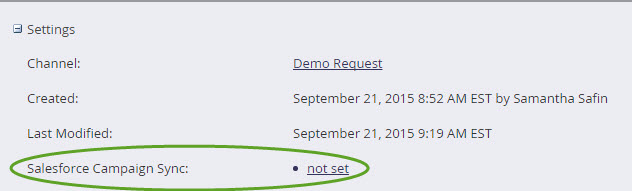
campaignselect
Under the Summary view of a Program, you can sync to a Salesforce Campaign

Assuming you want to do it my way, all you need do is create the program in Marketo, then go to its Summary page. Under settings you’ll see the Channel (which you cannot change), created and last edited information, and “Salesforce Campaign Sync,” which will be unset. If you click on “not set,” a popup screen will appear, from which you can select “Create New” from a drop down. And voila – you now have a Salesforce Campaign that will sync with your Marketo program.

campaignsync
Channel list, where you’ll control what channels you can assign to programs

If you want to use different names, you’ll need to create the Campaign in Salesforce and instead of selecting “Create New,” find the one that you’ve previously created.

A word of caution: If you have a lead scoring process, don’t sync any campaigns that could provide new names. This sync will overrule your lead scoring and sync the new names to Salesforce once they’re added, regardless of score.

Congratulations! You’ve created a Marketo program that will now speak directly to a Campaign in Salesforce! If your OWDs in Salesforce allow it, your SFDC users will now be able to track a person’s movement through a Program/Campaign.

Next up: Campaigns from Programs (this time, it’s Salesforce)

See Part 2

See Part 3

Destination: Destination Success

This is the first year that Salesforce University is putting on this all-training conference, aptly named “Destination Success,” and the clock is ticking. We take off Sunday for partly-cloudy and marginally warmer Las Vegas. I don’t know if it’s depressing that I think I’d be less excited about it if I weren’t headed towards 5 days of Salesforce kool-aid.

But I am headed towards 5 days of Salesforce.

First thing I’m excited about: free certifications. Ok…well…not free, since there is a fee to attend to the conference, but no fee on top of that registration. I could be walking away with 3 new certifications under my belt, stepping onto that return flight Friday afternoon with slightly more legitimacy.

Second thing I’m excited about: hands-on learning with Apex. They have multiple tracks for folks, but I opted for Developer 1.

Third thing I’m excited about (also maybe what I’m MOST excited about): I GET TO SHARE MY STORY! I was asked to participate in the Getting Started series that will be going on at the conference, where I’ll get to share with people just starting out what I learned just starting out. My goal is to not cry about how amazing everything is while I’m on stage. But I almost want to cry (tears of joy!) just thinking about it and writing about it now.

Fourth thing I’m excited about: hubby is going with. Sure, I’ll be busy during the day and even some evenings, but we’re going a day early, and we’ll be spending some time together on the strip. Mostly free vacation? Check.

Final thing I’m excited about: this is the first one ever. Those of us attending will get to give feedback that will shape any and all future conferences like this, and that is something I feel really blessed to do.

I’ll be busy next week, but I hope to post some highlights from the event, notes on how the hands-on training goes, and anything else I can think to share.

Sales Cloud for Marketing 1: Intro

I’ve had my fun, talking about myself, letting my freak flag fly, etc. But now it’s down to brass tax and all that. No one starts a Salesforce blog just to see their words on the screen (I  mean, that’s part of it) – they do it to give back to the community that offers them so much.

I’m no expert (obviously), but like most solo admins out there, I have a unique situation that has given me some insight that others might not have. You see, technically I work for my marketing team. I am the “Marketing Data and Systems Analyst,” which is totally cool, but it doesn’t accurately reflect what I do.

In reality, I support Marketing, Sales, Account Management (Client Services), and pretty soon, Customer Support potentially. I also help out our training team and our implementation team sometimes. I work with Finance. And sometimes I rub elbows with IT.

But technically I’m in marketing.

The bulk of my data analysis needs to be for both Marketing and Sales, which means most of my data management must balance both teams’ needs, as well. If I were to romanticize what I do, I’d say that I find ways to bridge the data gap between Sales and Marketing. In reality, I just have two cats that I’m constantly trying to herd into one place without them hissing territorially.

There are a few ways I’ve worked this out, and I intend to share them. For the record, my solutions thus far have depended on the following:

  1. We use the Enterprise version of SFDC, Sales Cloud only (so far)
  2. We are on the SMB-Select edition of Marketo

To keep things relatively short, I’m going to break this information out into a couple of posts to make a series, the Sales Cloud for Marketing series to be precise.

I’m going to cover a few things that I’ve learned herding these cats.

My first post in the series will be Marketo-heavy, and it will talk about some best practices on building Programs that will sync nicely with Salesforce. Those of you that use other marketing automation tools, the following part might be more applicable, and it will be making the case for making most, if not all, SFDC users “Marketing Users.”

I look forward to sharing this journey with you!


Did I mention I’m speaking at Marketing Nation Summit?

I love Salesforce. I love being a Salesforce admin. I love that it’s been a great path for me to start working on actual developer skills. It’s pretty fantastic.

It’s also not all I do. In addition to that, I’m my team’s Certified Marketo Expert. I suggest to anyone that is a Salesforce admin for a company that uses Marketo – at least become familiar with it. The way they work together is good to know and can really help in the design of extremely robust data management plans.

It’s been a wild ride so far, and a lot of the challenges I had when I took the keys to my Production Org were the same that I had with Marketo. Getting the engine running again was maybe even more difficult with Marketo because there are so many more places where people can make things go terribly, terribly wrong.

So this May, I’ll be speaking at Marketo’s Marketing Nation Summit about how I audited our Marketo instance and got it running a bit more smoothly.

I don’t have all of the details yet. In fact, I’m still just barely scratching the surface of how I’d like to present, but it’s been on my mind. I’m excited for this opportunity, and I wanted to share it. I’ll keep updates coming, as they seem necessary.

And if you’re also a Marketo user going to Summit – hey, hit me up!


Impromptu Salesforce Kool-Aid Post!

I’ve never been a joiner, ladies and gentlemen. I avoided pep rallies during high school. I avoided social clubs during college. During Institute at TFA, I declined any and all of the even remotely voluntary events (and some that were not so voluntary).

I’m only pointing out all of this because if you know me – or knew me earlier in life – you know that I am not a person who drinks the kool-aid. I am a person who sits in a corner, reading a book and eying the kool-aid suspiciously. So this post is a kind of a big deal.

If I could somehow bleed onto this post, I am 68% sure that instead of blood, there would just be blue clouds and SaSSy’s tumbling out and onto the digital page. Not to mention my Trailhead badges and strings of Apex code. As I have proclaimed to my coworkers, despite their eye rolls and confused smiles, today is a Salesforce day.

MVPs were announced. In case you somehow missed that. And one of my favorite people/amazing Salesforce mentor was renewed, which makes me super excited (Sarah Deutsch, in case you’re wondering. Show her some love). A lot of the names on the list made me super excited. It feels weird to say that I know some of them, that I’ve met them.

Melissa VanDyke, for instance. I met her at Midwest Dreamin’ last year, after I had an embarrassing fangirl moment. Actually, I had a series of embarrassing fangirl moments, and later, trying to explain to my boss how exciting it was to be in the same room as Mike Gerholdt, Gillian Madill, Brent Downey, and Melissa VanDyke was nearly impossible. I summed up by saying “they’re basically Salesforce celebrities. Just go with it.”

It’s why this community is so amazing, why it draws sucks people in, inspires, and thrives. I’ve seen other groups try to do the same thing, but it seems to fall short. There’s just something about this community.

And I got my Cloak of Adventure in the mail today! It was a sign, clearly, that today was a Salesforce day. So I’m off to seek some SFDC adventure this afternoon, and I’ve got this barrel of sweet, sweet kool-aid to take with me.

adventurecloak
Seeking adventure with Trailhead


You remember 95% of what you teach

Part of the Teach for America interview process involves creating a mini lesson and presenting it to a group of individuals who are also interviewing. Naturally, as I went through the process, I put together a lesson on…well, something English related; I honestly don’t remember the exact topic. I was an English major. I still live and die by the Oxford comma.

I got the email a week (or so) later, saying that I had been selected to join the ranks…as a middle school math teacher.

Math? Were they serious? I had never taken a class beyond pre-calculus in college. I almost said no.

Instead, I went to a used bookstore, bought all of the possible books I could find on math, and I started teaching myself things like limits and derivatives. Because in order to teach middle school, you have to be able to teach high school.

I passed the exam to teach math, but I didn’t really understand half of it until I started teaching it. Having to explain why the inverse of multiplication is division made me better understand fractions. I got really good at math while I was teaching it, and a lot of that came from how I was taught to plan lessons.

What does all of this rambling have to do with Salesforce?

I’ve discovered the exact same thing is true when it comes to, well, anything, but Salesforce specifically. I learn more about Salesforce when answering questions and training than I do by just studying.

This happens in two ways, which I will obviously share here.

Training new (and existing) users

I treat training the same way I treated my daily lesson plans. I plan them backwards – what do I want my user to be able to do? In order to perform that task, what do they need to know? What steps are necessary for them to get from point A to point B?

Example: I want users to know how to create a report on tasks that are due today. 

First thing’s first – I make that exact report, and I make note of every single step that I take. Every one of them. EVERY one. Each button click, each keystroke, each search, even the thought process behind those.

Then I make a list. What information do I take for granted that they might not know? For instance, I know that tasks in my instance can be related to up to three different records – Contacts, Accounts, or Opportunities. I know what those fields are called. I know that they are lookup fields. Do my users know that? Maybe, but I can’t assume that when I’m planning a lesson. What information do I kind of know but would be unable to explain in depth? That’s the stuff that I need to research.

The last step is actually planning what I’m going to say and do. I stick by the “I do, We do, You do” model, which just means that I will talk for about 5 minutes, demonstrate the actions and have them follow me, and then let them loose to try it out.

And I do that for every training session. Once you do it a few times, you really get used to it, and it doesn’t become quite so…daunting.

Answering questions

You’re obviously on the Salesforce Success Community because it’s pretty much a user’s/admin’s/developer’s best friend. So I know you’re there.

I used look for questions because I knew for sure someone had already asked what I was going to ask. Then I started seeing questions that people posted, and I would think “I kind of know what they mean.” But I would never answer their question! I was so afraid to just give my input.

Then one day I said “just try. What’s the harm?”

I learn more from answering questions sometimes than I do asking them. If I see a question out there that is lonely and has no responses, then I’ll start digging. If I know the answer, or have a good idea, I’ll double check my assumptions (I don’t want to steer people wrong, after all), and then I write an answer. Worst case scenario? My solution doesn’t quite work for them. They’re not going to cuss me out or tell me I shouldn’t be doing this job.

If I don’t know the answer, I try to find it anyway. Because reasons.

The Point?

If you want to learn more and get better, you need to teach. You need to force yourself to seek out the answers to questions that you didn’t know to ask yet, and you need to demonstrate and impart that knowledge. You’ll learn things you didn’t think you’d learn, and it will embed itself in your memory for a lot longer.

Shameless Self Promotion

I am rebranding this blog, as I mentioned in my first post in two years, conveniently titled “Rebranding (v)…”

Accordingly, I also wrote a blog post for my company about the importance of having a personal brand. It’s admittedly not transportation or logistics-focused, but as a company that employs people and actively tries to recruit them, we can’t talk about logistics all the time.

Anyway, it was very much a “do as I say” kind of blog post, and I hope to learn from it myself.

Given this whole time of branding, I thought I’d share it, in case you’re trying to define your career.

It’s here.

</promoting>

The Salesforce Blog Formula

Salesforce admins are a force (hahahahahaha) to be reckoned with. We are everywhere, and I mean that both literally abroad in the world and in cyberspace.

And, I’m just coming out and saying it because, guys, we all know. The thing is to change your persona; you get involved in Salesforce, and you’re no longer “Mike” or “Jane.” You enter your org, you make some custom fields, and you emerge, shiny and new as “MikeForce” and “JaneForce.”

Don’t act like it’s not a thing! Don’t even pretend. We all know it. I’m saying it.

And since this is now a Salesforce blog, I need to be talking about Salesforce, offering tips and tricks…

So here’s a formula that you can use in your Salesforce Dev Org (please don’t do this in Production) that will create your new Salesforce blog/twitter/etc. name.

We’ll assume you’re logged into your Dev Org. If you don’t have a Dev Org, go get one. They are free. They are amazing. They allow you to do things like make formula fields to generate your own new blog title without actual users asking what is going on. They also connect to Trailhead, so you can get badges for the practice you do.

So you’re logged into your Dev Org – go ahead and navigate to Setup, either via the word “Setup” in Salesforce Classic or by clicking on the gear icon in Lightning.

Use the Quick Search box and look up “Users” – alternatively, you can navigate to “Customize -> Users” in Classic or “Objects & Fields -> Object Management -> Users” in Lightning.

Select the “New” option to create a new field.

Here’s where the fun starts (switching to screenshots!):

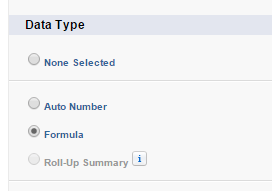
As mentioned, this is going to be a Formula field, so you’ll want to select “Formula” on the first screen.

formula Don’t let the name fool you. Formulas can be pretty much anything. They’re really just automatically uneditable fields.

Once you hit “Next,” you’re going to be able to label your Formula field and select what the output on that formula will be.

formulatypeI named mine, creatively, “Blog Title,” but the screenshot is from a previous run. The Field Label is yours to command, and the Field Name will update automatically. For return type, you’re going to select “Text.”
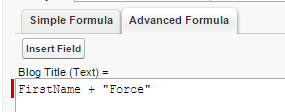
actualformulaFinally, the formula itself. Pretty simple one. You can either type in exactly what you see here, or if you want to make sure you’ve got the format correct, you can hit the button “Insert Field” and find “First Name,” then insert it.
The plus sign is literally just telling Salesforce to add the word “Force” after the value it’s taking from the First Name field. Make sure you put it in double quotes.

Check your syntax. Check syntax. Check it. All the time. Even if you know your formula is right. Even if you copied and pasted it from someone who knew it was right. Even if you copied and pasted it from Steve Mo, check your syntax.

Then save it.

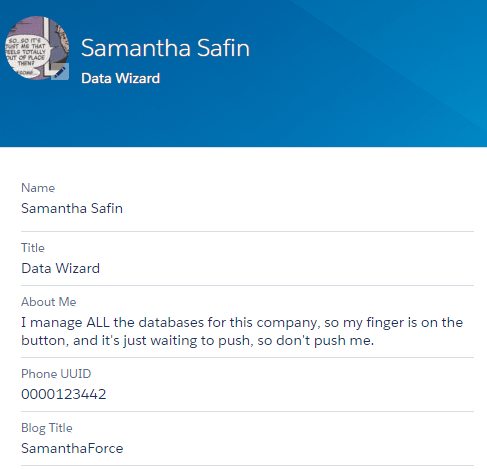
Check out a user profile – any user’s will do. Here’s mine, complete with my new Blog Title:

fieldinaction

So, of course my actual blog title is PolymathForce, but the format is the same.

Formula fields have been one of my most under-utilized Salesforce abilities. Like many admins just starting out, I spent a lot of time afraid of them. I imagined complex calculus fields, looking for the limit of x as it approached closing or something. But as I spend more time with them, get to know them, it turns out they’re totally chill.


Rebranding (v.) – what I’m doing now

I don’t mean to brag, but I took a marketing class in college to meet the requirements for a Business Administration minor. As useful as an English degree is, I thought having some semblance of business acumen to support it would be a good idea. That decision has paid off. So I know a little bit about marketing and branding.

And I’m not going to sit here and talk about how when I started blogging, it was done on LiveJournal, and it was the domain of angsty teenagers because frankly I’d rather not drudge up those memories. And the long string of neglected URLs out there with one of my email addresses attached to them is testament enough to my level of commitment to those outlets.

But I did some great writing under the guise of The Crafty Polymath, and I didn’t want to shove it into a closet to collect dust. It’s just not valid anymore – I don’t spend my weekends at a desk adorned with fabric and a sewing machine. I spend it in front of a tv with a PS4 controller in my hands, to be 100% honest.

What is valid, though, is what I do at least 5 days a week.

Scroll down to my last post; I’ll wait. You didn’t scroll, did you? Rebel. I mention a new job, and the funny thing is that since that new job, I started another new job with the same company.

Enter Salesforce, stage right and Marketo, stage left. They meet in the middle and integrate surprisingly well.

That was almost 2 years ago, and I am swallowing my embarrassment here to try this again.

This whole thing – the job, Salesforce, Marketo – has been an unexpected delight. It’s kind of right up my alley because my title, Marketing Data & Systems Analyst, is vague enough that if there’s something I want to do, I can pretty much do it. I manage various software systems; I analyze data; I help plan marketing strategies; I write and edit content sometimes; I design landing pages and make emails responsive. In other words, ladies and gentlemen, I’m paid to be a freaking polymath.

I feel like the name of this blog should give away how exciting that is for me.

It also has opened up a door to an actual, honest-to-God career path, complete with professional development, built-in networking, and recognition for knowing what’s what.

Case in point: I started the West Michigan Women in Tech Salesforce User Group. Admittedly, the name is a bit of a mouthful. But this lady here, who only ever joined clubs that encouraged solo work, is getting involved. With people. And events. It’s a big deal. And within this process, some new-found friends (all of my new-found friends) have asked me “do you have a blog?”

Cue my awkward, “well, yeah, kinda, but it’s…I mean…please don’t go there. I haven’t posted in two years.”

And honestly, it’s a thing with Salesforce. We write stuff, we admins and developers. We shout about Salesforce all the time. That is not even an exaggeration; I’ve been trying to recruit my mom for a month. And my husband has had to sit through me endlessly gushing about validation rules and formula fields and “did you know Salesforce can do this?!”

I’m not going to make any promises here about posting every week. Not yet. Let me sink my feet in a little and get this rolling. Let me find my rhythm, my words. Let me make peace with the fact that, as an admin in a kind of marketing role, I might have a unique and interesting perspective to share.

But if you have a spare minute, here or there, and if you enjoy self-deprecating humor, then my friend…this isn’t a bad place to find yourself.

Consider the Crafty Polymath officially rebranded.


An empty apology

I signed in on a whim. I haven’t bothered to go back and see when my last post was because I feel confident it would only be another log to add to a fire of guilt over my lack of posts. 

For Valentine’s Day, I set up an account for my husband to promote his games and miniatures painting, and he’s been (mostly) diligently posting once a week. And I’m supposed to be the writer in our house.

I guess I could blame the weather – worst Michigan winter on the books according to some. I could say that starting a new job has been hectic. Working in transportation makes it doubly difficult, given said weather. Maybe it’s a malaise or lack of sleep or not crafting…

In reality, I’ve just been otherwise occupied. We’ve painted three rooms in our house, put in “raised” beds for a garden, extended our patio and built a fire pit, ran a 5k, and sold some goods at a comic convention up North. I’ve enrolled in classes to pursue a second degree. I made a dress form. I made decorations for the house, and we made a handful of little gifts for Christmas. I put together a creative year of dates a la Pinterest, and I have made some delicious dinners and desserts. I’ve been making and baking like a fool. I even have pictures.

But I’ve not bothered to write any of it down, at least not where others can enjoy learn from reading about my mistakes.

So I’m sorry about that, I guess. I will certainly try to keep writing and sharing my stories – I have plenty to share at this point – at least more frequently that I have been.